Accountability - The Game Changer
What does accountability really mean?
In leadership workshops, team development, or even in our personal lives, we talk about accountability all the time. But let’s be honest: do we really know what it means?
“Accountability” has become a blur word, a term that sounds powerful but often lacks a clear, shared definition. We say things like “Accountability is important” or “It’s one of my values”, but everyone interprets it differently. The result? Confusion, frustration, and misaligned actions.
I believe that language shapes behaviour.
When we use vague terms for something as essential as accountability, we risk promoting misunderstanding rather than clarity.
That’s why it’s not enough to simply say, “We need accountability.”
We need to understand what that looks like and how it shows up in our thoughts, communication, and daily actions.
One model I find particularly helpful in creating this understanding is the Accountability Ladder.
Accountability Ladder — A Model for Awareness
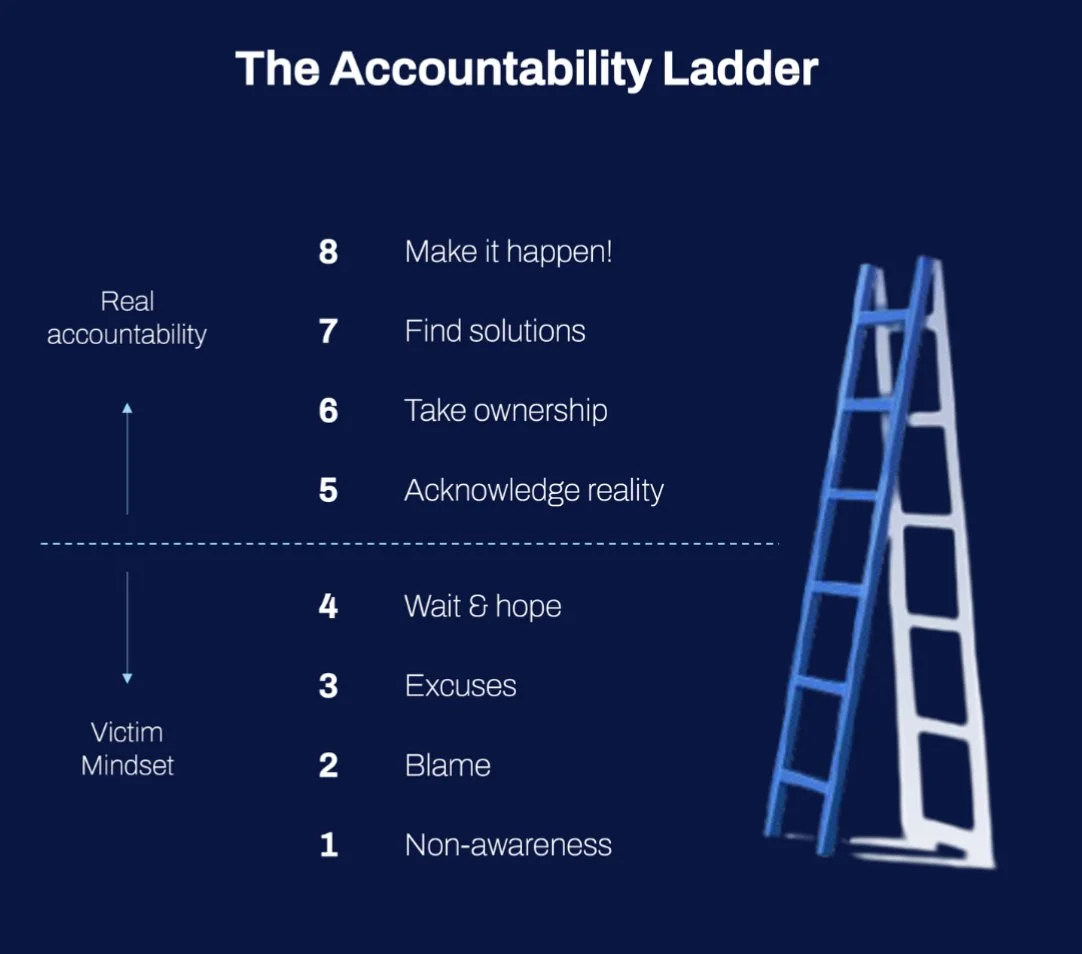
The Accountability Ladder divides behaviours into two main sections:
the victim mentality (lower section) and the doer attitude (upper section).
The Lower Section: The Victim Mentality
In this section, responsibility is externalised. We shift blame to circumstances, other people, or “bad luck.”
Denial – “What problem?”
The problem is ignored or denied. We refuse to see what’s not working.Blaming Others – “It’s not my fault.”
Responsibility is deflected. Someone else is always to blame.Excuses – “Yes, but…”
We rationalise why something didn’t work. Excuses replace action.Wait and Hope – “Let’s see… maybe it’ll sort itself out.”
Here we delay decisions, waiting passively for circumstances to change.
At these stages, there is no true accountability.
We act reactively rather than proactively. This mindset often leaves us feeling powerless, frustrated, and dependent on external factors.
The Upper Section: The Doer Attitude
Moving upward, accountability begins to take shape. Responsibility is internalised and we start seeing ourselves as part of the solution.
Acknowledging Reality – “I see the problem.”
You face the truth of the situation with honesty and openness.Taking Responsibility – “That was my responsibility.”
You own your part, admit mistakes, and stop deflecting blame.Finding Solutions – “I’ll find out what went wrong and how to fix it.”
You shift your focus from fault to learning and problem-solving.Make It Happen – “I’ll take action and deliver.”
You move into implementation and accountability in action and creating results through conscious effort.
Progress and development occur here, in the upper section.
It’s not about perfection — it’s about empowerment.
We see ourselves as having influence, choice, and the ability to make a difference.
From Awareness to Change
The key insight?
We are all constantly moving up and down this ladder.
It’s not a label that defines us, but a snapshot of where we currently stand and where we can grow.
Shifting upward on the ladder starts with awareness. Once we notice our current stage, we can ask ourselves:
What is one step I can take to move up the ladder?
That step might be as simple as acknowledging a problem instead of avoiding it, or as bold as taking ownership and taking action.
How Counselling Can Support the Climb
In counselling, accountability is not about blame — it’s about empowerment.
It’s about recognising patterns, taking ownership of what we can influence, and building the confidence to make change happen.
By exploring the “why” behind our reactions, we can transform feelings of helplessness into awareness and action.
Counselling provides a safe space to reflect and grow, one step at a time.