When Tension Turns into Conflict: Understanding Escalation Before It Goes Too Far
Conflict is a natural part of human relationships. Whether in families, workplaces, friendships, or partnerships, disagreements arise simply because people bring different histories, needs, and communication styles to the table.
What truly matters is how early we notice tension and how we respond to it.
In counselling, I often see people who didn’t realise how gradually a simple disagreement turned into something painful, overwhelming, or destructive. Many are surprised at how quickly conversations can spiral once emotions take over.
To help us understand this process, conflict researcher Friedrich Glasl developed a model that maps the stages of escalation. While originally used in organisational settings, it offers valuable insight into personal relationships as well.
Below is an overview of the patterns we commonly see when conflict grows and why early awareness is so important.
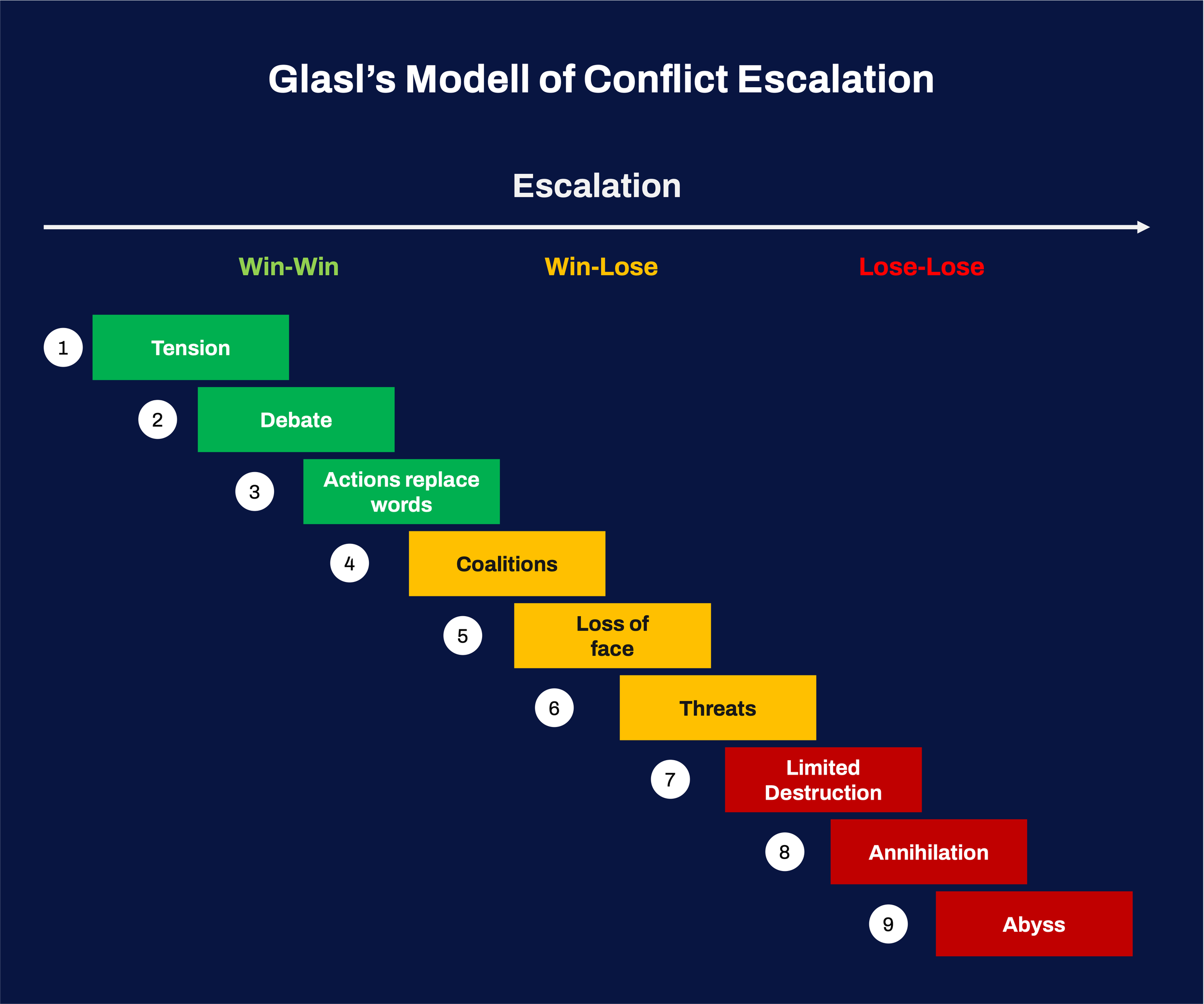
Image from Team Jenewein
Phase 1: Early Tension — Still Repairable, Still Respectful (Win–Win)
In the beginning, people can still listen to each other. Misunderstandings are uncomfortable, but both sides remain open to a constructive outcome.
1. Emerging tension
Different opinions appear, but conversations remain polite.
People still try to understand each other.
2. Argument and emotional reactions - Debate
Voices get sharper.
Old frustrations may resurface.
Misinterpretations and assumptions start to guide the conversation.
3. Acting instead of talking
Communication shuts down.
Each person starts “doing their own thing” to avoid confrontation, or to push their view through without discussion.
At this stage, counselling works extremely well.
Both sides can still reflect, reconnect with their intentions, and move towards repair.
Phase 2: The Conflict Becomes Personal (Win–Lose)
Once emotions dominate, people start protecting themselves rather than solving the issue. The focus shifts from the relationship to “being right”.
4. Taking sides and building allies - Coalition
Partners involve friends or family for reassurance.
At work, colleagues form small groups.
Stories are shared to secure support rather than to seek understanding.
5. Hurt pride and loss of trust
People feel exposed or humiliated.
Small comments sting more deeply.
There is less willingness to be vulnerable.
6. Threats - subtle or direct
Ultimatums appear (“If this doesn’t change, I’m done”).
Power, guilt, or withdrawal is used to influence the outcome.
This is usually the moment when individuals or couples seek counselling — often saying,
“We don’t know how it got this far.”
Phase 3: When Connection Breaks Down (Lose–Lose)
At this point, both sides feel deeply misunderstood or wronged. The conflict no longer has a clear goal — the pain itself drives the behaviour.
7. Intentional hurt or Limited Destruction
Actions are taken that knowingly affect the other person, even if they also create self-harm or long-term damage.
8. Attacking what matters - Annihilation
Important aspects of someone’s life — relationships, work, reputation, routines — become targets.
9. Mutual destruction - Abyss
If the conflict reaches this point, both sides lose significantly.
Counselling is still helpful here, but the focus shifts to crisis support, emotional stabilisation, and rebuilding safety.
Why Early Intervention Matters
Conflicts rarely explode out of nowhere.
They creep, accumulate, and tighten until communication becomes distorted and defensive.
The earlier someone reaches out for help — individually, as a couple, or as a family — the easier it is to:
restore understanding
clarify needs and boundaries
reduce emotional reactivity
rebuild connection
prevent long-term relational damage
Ignoring tension might feel easier in the moment, but it almost always increases the emotional cost later.
A Reflection for You
Is there a conversation you’ve been avoiding — at home, with a partner, or at work?
Are there early signs of frustration, sarcasm, withdrawal, or misunderstandings?
Addressing these early can prevent unnecessary pain and strengthen your relationships.
If you’d like help working through a conflict or understanding its dynamics, counselling offers a safe and supportive space to unpack what’s really going on — before it escalates.